LTO Student Permit Requirements: Age, Fees, Documents, and the TDC
A Student Permit is the first official step toward getting a Philippine driver’s license, and it’s where every first-time applicant’s licensing journey legally begins. This guide covers exactly who qualifies, what documents to prepare, what the Theoretical Driving Course involves, and how much the whole process costs.
Last updated for 2026. LTO requirements and fees are set through official circulars and administrative orders and can be revised, so confirm current details through the LTMS Portal or your LTO office before applying.
A note on timing: Under Memorandum Circular No. MVL-2026-5271, LTO additionally extended the validity of student permits and medical certificates due for renewal or expiration starting July 1, 2026, nationwide, until further notice, because of ongoing LTMS system issues, with no late fees during the extension. This is on top of the standard renewal process described below, and it’s a dated advisory rather than a permanent rule, so confirm with LTO or the LTMS Portal whether it still applies when you read this.
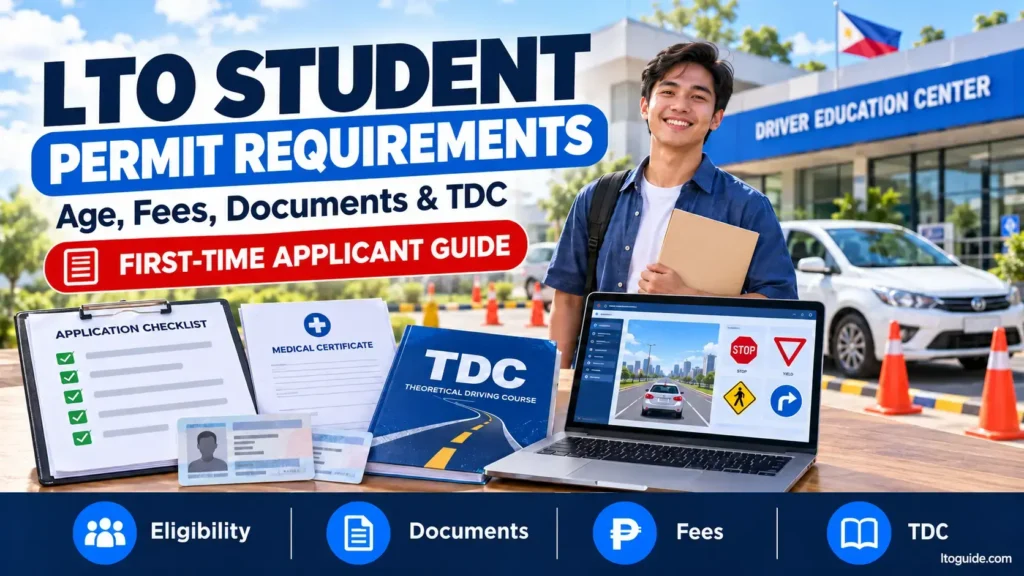
LTO Student Permit Requirements: Quick Checklist Before You Apply
- Confirm you meet the minimum age requirement
- Complete your 15-hour Theoretical Driving Course (TDC) and secure your Certificate of Completion
- Get a medical certificate from an LTO-accredited clinic or physician
- Gather one of the accepted identity documents (PSA birth certificate, PhilID, or passport) and a valid ID with your photo and signature
- If you’re under 18, prepare a parent or guardian’s consent and their valid ID
- Create your LTMS Portal account in advance, since your LTO Client ID comes from it and most offices expect you to have one
Who Can Apply for an LTO Student Permit: Age and Eligibility Requirements
Filipino citizens must be at least 16 years old to apply. Foreign nationals must be at least 18, with an entry date at least one month before applying and a visa valid for at least six months from the application date.
If you come across an older guide citing 18 as the minimum age for Filipino applicants, that traces back to the original 1964 text of RA 4136, which has since been superseded by current LTO practice.
Applicants under 18 need a parent or guardian’s consent, along with a valid government ID showing that parent’s, guardian’s, or custodian’s photo and signature, submitted with the rest of the application.
Beyond age, applicants also need to be physically and mentally fit to drive, able to read and write in Filipino or English, and free of unsettled traffic violations tied to their name.
Student Permit Document Requirements: What You Need to Bring
Requirements can be adjusted by LTO from time to time, but based on the current official checklist, you’ll generally need:
- A completed Application for Permits and Licenses (APL) form
- One of the accepted identity documents, original and photocopy: a PSA birth certificate, PhilID card, passport, Local Civil Registry record (where PSA records aren’t available), or PSA marriage certificate
- Any issued ID with your photo and signature, original and photocopy. This doesn’t have to be government-issued
- A medical certificate from an LTO-accredited clinic or physician, electronically transmitted to LTMS, plus a hardcopy to bring with you
- Your TDC Certificate of Completion, electronically transmitted by your course provider
- Your TIN, if you’re employed
- For applicants under 18: a parent or guardian’s consent, plus their valid government-issued ID showing photo and signature
- For foreign applicants: a passport showing an entry date at least one month before applying and a visa valid for at least six months from the application date, or a PSA-authenticated birth certificate if born in the Philippines
- An LTO Client ID, which you get by creating an LTMS Portal account beforehand
Bring both original documents and photocopies, since LTO offices generally verify the original and keep the copy.
TDC Requirement for Your LTO Student Permit
The TDC is a mandatory requirement for every first-time applicant. It’s a 15-hour course covering traffic laws, road signs, right-of-way rules, and general driving theory, with no actual behind-the-wheel component.
You have two ways to complete it:
At an LTO Driver’s Education Center (DEC). This option is free, though availability and scheduling can take longer depending on your area.
Through an LTO-accredited driving school or online provider (OTDC). This is generally faster to book. An online course isn’t just a set of video lessons: it typically includes a quiz after each module, a final validation exam once all modules are done, and a Certificate of Completion issued only after you pass. Under LTO Memorandum Circular 2023-2390, driving schools and online providers can charge a maximum of ₱1,000 for the TDC specifically; the same circular sets separate, higher caps for the practical driving course.
You need to complete the course within two years of your first session. We cover the TDC final assessment, along with the full written exam system for driver’s license applicants, in more detail in our LTO Exam Guide.
TDC vs. CDE Online Validation Exam: A Common Student Permit Mix-Up
If you searched for “CDE online validation exam” and landed here expecting it to be a requirement at this stage, it’s worth clarifying directly: the CDE Online Validation Exam is a separate exam tied specifically to driver’s license renewal, not to first-time application. The TDC is the one that applies here. These two get mixed up often enough online that it’s worth double-checking which one actually applies to your situation before you start studying.
How Much Does a Student Permit Cost?
The LTO Citizen’s Charter 2025 1st Edition lists the Student Driver’s Permit fee as ₱150 plus a ₱100 application fee, for a standard total of ₱250. Some other guides cite a higher total of ₱317.63, adding a separate ₱67.63 computer fee on top of that, so this is worth confirming directly, since it’s unclear whether that computer fee is still being collected everywhere. On top of the government fee:
- Your medical certificate, which isn’t a government-set fee and varies by clinic
- Your TDC, free at an LTO Driver’s Education Center, or up to ₱1,000 at an accredited driving school or online provider under the current price cap
Confirm the current fee breakdown through LTMS or with your LTO branch before your appointment, since fees are periodically revised.
How Long Is a Student Permit Valid, and What Happens When It Expires?
It’s valid for one year from its issue date. After that year, you can no longer use it to take the Practical Driving Course, but if you already completed your PDC while the permit was still valid, your permit remains usable for your Non-Professional license application even after it expires, subject to the two-year rule below.
An expired permit isn’t a dead end. You can renew it, and LTO collects only the basic fee at renewal unless you have unsettled traffic violations to clear. The one exception is at the two-year mark from your original issuance date: at that point, LTO requires you to apply for a new Student Permit, bearing the same permit number, rather than a simple renewal, and your required holding period restarts from that new permit’s issuance. Your training records, including your completed TDC and PDC, are retained regardless, so you don’t lose credit for coursework you’ve already finished.
To apply for a Non-Professional driver’s license, you need a permit that’s been valid for at least one month, in addition to meeting the Non-Professional license’s own minimum age of 17 and completing the Practical Driving Course. Turning 16 and getting your permit doesn’t by itself mean you can get your driver’s license a month later if you haven’t also turned 17 by then.
Can I Drive Alone With a Student Permit?
No. Under RA 4136, a student driver may not operate a vehicle unless accompanied by a duly licensed driver, who sits with them and is legally responsible for violations or damage that occur during the lesson. It doesn’t authorize solo driving on its own.
How to Apply for a Student Permit
In person:
- Go to an LTO office and get the Application for Permits and Licenses (APL) form.
- Take a queue number and wait to be called.
- Submit your requirements for evaluation.
- Once approved, have your photo and signature captured.
- Pay the applicable fees at the cashier.
- Claim your permit at the releasing counter.
Online, through the LTMS Portal:
LTO has been expanding online processing for licensing transactions, but an in-person office visit is still required either way, for biometrics and photo capture, and to claim the printed permit. Your medical certificate and TDC certificate reach LTMS electronically from your clinic and course provider directly, not through a self-upload step. Create your LTMS Portal account and secure your LTO Client ID well ahead of time, then confirm with your LTO office or the portal what the current online portion of this specific transaction covers.
Common Mistakes When Meeting Student Permit Requirements
Assuming the CDE Online Validation Exam applies at this stage is a frequent mix-up, since it’s actually a renewal-specific exam, not part of first-time application.
Submitting a medical certificate from a clinic that isn’t LTO-accredited can get your application rejected outright. Confirm accreditation before your appointment rather than after.
Assuming you can drive by yourself once you have one is a common and risky misunderstanding. You’re legally required to have a duly licensed driver with you at all times while driving on it.
Applying for your Non-Professional license based on the one-month holding rule alone, without checking that you’ve also turned 17, is an avoidable rejection at the counter.
Assuming an expired Student Permit is unrecoverable and that you’ve lost your completed TDC and PDC is a common worry that isn’t quite accurate. Renewal is generally possible, and your training records are retained. The one real deadline is the two-year mark from your original issuance date: past that point, LTO requires a fresh permit and a restarted holding period instead of a simple renewal.
Frequently Asked Questions About LTO Student Permit Requirements
16 years old for Filipino citizens. Foreign applicants must be at least 18. Older guides citing 18 for Filipino applicants are referencing the original 1964 text of RA 4136, which current LTO practice has superseded.
One year from the date of issue. It can still be renewed after it expires, generally for just the basic fee, though LTO requires a brand-new permit instead once you’re two years past the original issuance date.
No. The CDE Online Validation Exam applies to license renewal, not to first-time application. The TDC is the requirement that applies at this stage.
15 hours, covering traffic laws and road safety theory. There’s no practical driving component in the TDC itself, and you have up to two years from your first session to complete it.
It’s free at an LTO Driver’s Education Center. At an accredited driving school or online provider, the current price cap under LTO Memorandum Circular 2023-2390 is ₱1,000.
Yes, through LTO-accredited online providers (OTDC). Expect module quizzes and a final validation exam before you receive your certificate, not just a set of videos to watch.
No. RA 4136 requires a student driver to be accompanied by a duly licensed driver at all times while operating a vehicle.
You can generally renew it. If you already completed your Practical Driving Course while the permit was valid, that PDC still counts toward your Non-Professional license application even after the permit expires, as long as you stay within the two-year rule below. A fresh permit, rather than a renewal, becomes necessary once you’re two years past the original issuance date.
Yes, foreign nationals at least 18 years old can apply, generally with an entry date at least one month before applying and a visa valid for at least six months from the application date.
Final Thoughts on LTO Student Permit Requirements
Getting a Student Permit comes down to three things: meeting the age and document requirements, completing your 15-hour TDC through either a free DEC session or a capped-fee accredited provider, and applying for your Non-Professional license once you’ve held a valid permit for at least a month and turned 17. If your permit expires along the way, renewal is usually straightforward, and your completed coursework isn’t lost. Just remember that driving on a Student Permit always requires a licensed driver beside you.
Once you’ve held your permit long enough to apply for your actual license, see our Driver’s License Types and Application guide for the next steps, and our LTO Exam Guide for what to expect on the written and practical exams.