LTO Vehicle Registration Renewal: Schedule, Requirements, Fees & OR/CR
If you own a car or motorcycle in the Philippines, your registration renewal date isn’t something LTO reminds you about. It’s tied to your plate number, and after the initial registration period, most vehicles follow an annual renewal schedule. This guide walks through exactly how that schedule works, what OR/CR and your MV File Number actually mean, what documents you need, and the specific legal grounds under which a registration can be suspended.
Last updated for 2026. LTO requirements, fees, and any temporary extensions change periodically, so always confirm current details through the official LTMS Portal at portal.lto.gov.ph or your regional LTO office.
Before You Renew: Quick Checklist
- Check your plate or MV File Number to confirm your renewal month and week
- Check for outstanding traffic violations or alarms tied to your vehicle
- Confirm your CTPL insurance coverage is active
- Complete any required emission testing or inspection
- Have your OR/CR, valid ID, and TIN (if applicable) ready
- Confirm your LTMS account is set up and your vehicle is linked to it, if you plan to renew online
- Check LTO’s official channels for any current extension or schedule announcement
What Do OR and CR Actually Mean?
OR stands for Official Receipt, and CR stands for Certificate of Registration. Together, “OR/CR” refers to the two documents that prove your vehicle is legally registered: the OR shows you paid the registration fee, and the CR is the actual registration record tied to your vehicle and its owner.
You’ll need your OR/CR for nearly every LTO transaction involving your vehicle: renewal, transfer of ownership, and even some insurance or loan processes. If you buy a used vehicle, checking that the OR/CR matches the seller’s identity is part of how ownership gets verified before a sale goes through.
What Is an MV File Number?
Your MV File Number is the reference number assigned to your vehicle’s registration record within LTO’s system. It appears on your CR. The last digit of your plate number generally determines your renewal month. For vehicles that don’t yet have an assigned plate, keep your MV File Number available, since LTO uses it to identify the vehicle record. Check your OR/CR or LTMS record for the renewal details that apply to your specific case.
The LTO Vehicle Registration Renewal Schedule
Unlike Metro Manila’s number coding scheme, which restricts when you can drive, vehicle registration renewal is a completely separate, nationwide system that determines when your registration is due. It’s easy to confuse the two since both are based on your plate number, but they serve entirely different purposes and don’t share a schedule.
Your renewal schedule works on two digits:
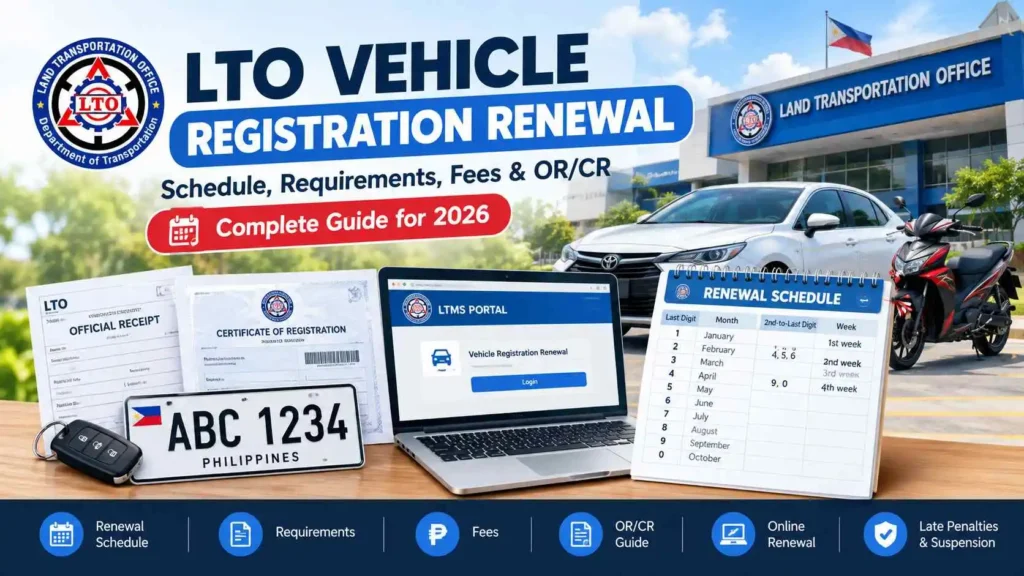
Last Digit of Plate | Renewal Month |
1 | January |
2 | February |
3 | March |
4 | April |
5 | May |
6 | June |
7 | July |
8 | August |
9 | September |
0 | October |
The second-to-last digit determines your usual registration week, subject to the applicable working-day schedule:
2nd-to-Last Digit | Usual Renewal Week |
1, 2, 3 | 1st week |
4, 5, 6 | 2nd week |
7, 8 | 3rd week |
9, 0 | 4th week |
Example: Plate ending in 47. The last digit is 7, so the renewal month is July. The second-to-last digit is 4, which falls in the 2nd week. So the usual renewal period is the second week of July, subject to the applicable working-day schedule for that year.
Brand-new vehicles work differently. When you buy a new car or motorcycle, it can receive an initial registration period of up to three years under applicable LTO rules, typically processed by the dealer. After that initial period, the vehicle moves onto the regular annual renewal schedule based on its plate’s last two digits.
You’re generally allowed to renew ahead of your assigned month, which is worth doing if you know you’ll be busy or traveling when your actual renewal week comes up.
Registration Extensions: What They Actually Are
You may come across the term “LTO registration extension” while searching. This refers to LTO occasionally announcing a temporary grace period for specific plate-ending groups, typically during emergencies or major disruptions, where the usual penalty for renewing late is waived for a defined extra window. These aren’t something you request individually. They’re official, agency-wide announcements that apply to everyone in the affected group.
Because extensions are situational and not a standing policy, check LTO’s official social media channels or the LTMS Portal for any current announcement rather than assuming one automatically applies to your plate ending.
What You Need to Renew Your Registration
Requirements can vary by vehicle type, transaction history, and current LTO rules, but for a standard private vehicle renewal, you’ll generally need:
- Your current OR/CR, where required for the transaction
- A valid Compulsory Third Party Liability (CTPL) insurance Certificate of Cover (COC), which your insurer typically transmits electronically to LTMS
- Applicable MVISR/MVIR or inspection documentation required by LTO. Depending on the transaction, the process may involve a PMVIC inspection or emission testing paired with the applicable LTO inspection procedure
- A Certificate of Emission Compliance (CEC), where applicable, such as when the vehicle is not inspected at a PMVIC
- No outstanding, unsettled traffic violations or active alarms tied to the vehicle
- Any additional documents required for your vehicle classification or transaction
- A valid government-issued ID, and your TIN where the transaction calls for it
A permanent alarm or an unsettled traffic violation that blocks the transaction can prevent registration renewal until the issue is resolved with the agency that issued it.
How Long Is the Inspection Report Valid?
Your Motor Vehicle Inspection Report is valid for 60 days from the date of inspection. If your renewal transaction isn’t completed within that window, you’ll typically need a fresh inspection.
Can You Renew Your Vehicle Registration Online?
Yes, for plain renewal transactions, though there’s an important catch: online renewal is only available if your vehicle is already linked to your LTMS account from a previous in-person transaction. If this is your first time renewing, or your vehicle has never been linked to an LTMS account, you’ll need to visit an LTO office in person first. After that, subsequent renewals can generally be done online.
The general online renewal flow looks like this:
- Secure your CTPL Certificate of Coverage from your insurer, who transmits it electronically to LTMS.
- Complete the applicable inspection route for your vehicle; results are transmitted electronically to LTMS.
- Log in to your LTMS Portal account and go to the Vehicle section.
- Select the renewal transaction for your vehicle. The system should pull in your COC and inspection data automatically once both have been transmitted.
- Review and validate the details shown.
- Pay the renewal fee through your chosen payment method.
- Receive your digital Official Receipt by email, which also becomes viewable in your LTMS account.
Exact screens and steps can change as LTMS is updated, so treat this as the general sequence rather than a precise click-by-click guide, and follow whatever the portal currently shows you.
Registration Fees: What Makes Up the Cost
Total renewal costs vary by vehicle type, weight class, and current rates, so rather than quoting a fixed peso figure that may be outdated, it helps to know what the total is actually made up of:
- The Motor Vehicle User’s Charge (MVUC)
- Registration-related fees tied to your vehicle classification
- CTPL insurance premium
- Emission testing and, where applicable, PMVIC inspection costs
- Late penalties or surcharges, if you’re renewing past your assigned week
- Any other transaction-specific charges for your vehicle type
Check the current fee breakdown through LTMS or with your LTO branch before your appointment rather than budgeting around an older figure.
What Happens If You Renew Late?
Late renewal typically results in penalties and additional charges on top of your normal registration fee. The exact amount depends on current LTO rules and how far past your assigned week you are, so rather than relying on an old fixed peso amount, check the current assessment through LTMS or with your LTO office. Separately, driving with a delinquent, suspended, or invalid registration, or without your correct plate for the current period, carries its own penalty under RA 4136 and can result in apprehension.
When Registration May Be Suspended
Under Republic Act 4136, Section 16, registration may be refused or suspended when inspection finds the vehicle unsightly, unsafe, overloaded, improperly marked or equipped, otherwise unfit to operate, capable of causing excessive damage to public highways, or not conforming to required minimum standards and specifications.
When this happens, the law requires LTO to give the vehicle owner 72 hours’ notice, and the plates may need to be surrendered. The suspension stays in effect until the vehicle’s defects are corrected and it meets the required standards again.
Motorcycle Registration: What’s Different
Motorcycle registration follows the same basic schedule logic, last digit for month, second-to-last for week, and requires a similar set of documents, though specific requirements and fee amounts differ from four-wheeled vehicles. If you’re registering or renewing a motorcycle specifically, it’s worth confirming current requirements directly, since motorcycle-specific rules have seen more frequent changes in recent years than standard car registration.
Common Mistakes When Renewing Registration
Confusing your registration renewal schedule with Metro Manila’s number coding schedule trips up a lot of vehicle owners, since both use your plate’s last digit but govern completely different things.
Assuming your CTPL or inspection results transmitted automatically, without confirming with the provider, is a frequent cause of delays at the counter.
Waiting until the last day of your assigned week instead of the first leaves no room for a problem, like an unresolved violation or a failed inspection, to be fixed in time.
Assuming a past registration extension still applies to your current renewal is another common mix-up. Extensions are tied to specific announcements and time windows, not a permanent rule for your plate ending.
Letting your inspection report sit longer than 60 days before completing the renewal means starting the inspection step over.
Frequently Asked Questions
OR stands for Official Receipt, proving you paid your registration fee, and CR stands for Certificate of Registration, your vehicle’s official registration record. Together they’re the core documents proving your vehicle is legally registered.
The last digit of your plate number determines your renewal month, and the second-to-last digit determines your usual week within that month.
No. They both use your plate’s last digit, but they’re separate systems. Number coding restricts when you can drive in Metro Manila; registration renewal is a nationwide schedule for keeping your vehicle’s registration current.
It’s your vehicle’s reference number within LTO’s system, found on your CR. It’s used to identify your vehicle record for renewal and other transactions, particularly when your vehicle doesn’t yet have an assigned plate number.
Yes, for plain renewals, but only if your vehicle is already linked to your LTMS account from a prior in-person transaction. First-time linking requires an LTO office visit.
You’re generally allowed to renew ahead of your assigned month; confirm the current allowable window through LTMS, since this has varied over time.
60 days from the date of inspection. If your renewal isn’t completed within that window, you’ll generally need a new inspection.
You can still renew, but expect late penalties and surcharges on top of the normal fee, with the exact amount depending on current LTO rules and how overdue you are.
Generally, no. A permanent alarm or unresolved traffic violation typically needs to be settled with the issuing agency before your renewal can proceed.
Under RA 4136, Section 16, LTO can suspend a registration if inspection finds the vehicle unsafe, overloaded, improperly equipped, unfit to operate, or capable of causing excessive damage to public roads. The owner gets 72 hours’ notice, and the suspension lifts once the vehicle is brought back into compliance.
Final Thoughts
Vehicle registration renewal in the Philippines runs on a predictable schedule once you know your plate’s last two digits, but the details, CTPL, emission and inspection requirements, and a clean violation record, are what actually determine whether your renewal goes smoothly. Keep track of your specific month and week, gather your documents ahead of time, and don’t assume an old extension still applies to you.
For help with your LTMS account itself, see our LTO Portal guide. If you’re specifically trying to track a plate’s manufacturing or delivery status rather than renew an existing registration, see our LTO Plate Tracker guide.