LTO Plate Tracker: How to Check Your Plate Number Status and Read Philippine Plates
If you’ve ever typed “LTO plate tracker” into Google while waiting for a new plate that seems to have vanished into the system, you’re not alone. Plate delivery delays have been a real, long-running problem in the Philippines, and knowing exactly how to check your status, and how to tell a legitimate tracker from a copycat site, makes the wait a lot less stressful.
This guide covers how official plate tracking actually works, what the status messages mean, how to read the letters and numbers on your plate, and what to watch out for when searching for a tracker online.
Last updated for 2026. LTO systems, URLs, and backlog timelines change periodically, so always confirm current details through the official LTO website or your regional LTO office.
What Is the LTO Plate Tracker?
If you’re looking for an LTO plate tracker in the Philippines, it’s important to know which tracking service is currently available for your transaction.
LTOTracker is a real, official digital platform developed by LTO and the Department of Transportation (DOTr), launched in live testing on April 26, 2025. It lets motorists check the real-time status of their driver’s license and vehicle plates, and offers home delivery through accredited couriers instead of requiring an in-person pickup.
The platform exists because of a genuinely long-running problem: LTO’s vehicle plate manufacturing backlog dates back to 2014, and it left many vehicle owners driving for months, sometimes years, on paper conduction stickers while waiting for a permanent plate. Separately, motorcycle owners have their own specific deadline to be aware of: Republic Act No. 12209, signed May 9, 2025, amended the Motorcycle Crime Prevention Act (RA 11235, the “Doble Plaka” law) to require bigger, readable, color-coded motorcycle plates and remove the front-plate requirement, and it gave LTO until June 30, 2026 to produce, release, and issue these new motorcycle plates specifically.
One important update: LTOTracker’s original central website was shut down in 2026, and tracking now runs through separate regional tools instead of one central platform. For vehicles and motorcycles processed through LTO-NCR offices specifically, the official LTO-NCR website currently provides three distinct inquiry tools depending on your transaction type, covered below. If your vehicle was registered outside Metro Manila, the equivalent tool is typically run by your regional LTO office rather than a single national tracker, so start from the official LTO website or your regional LTO’s own page rather than relying on an old bookmarked URL.
How to Check Your Plate Number Status (LTO-NCR)
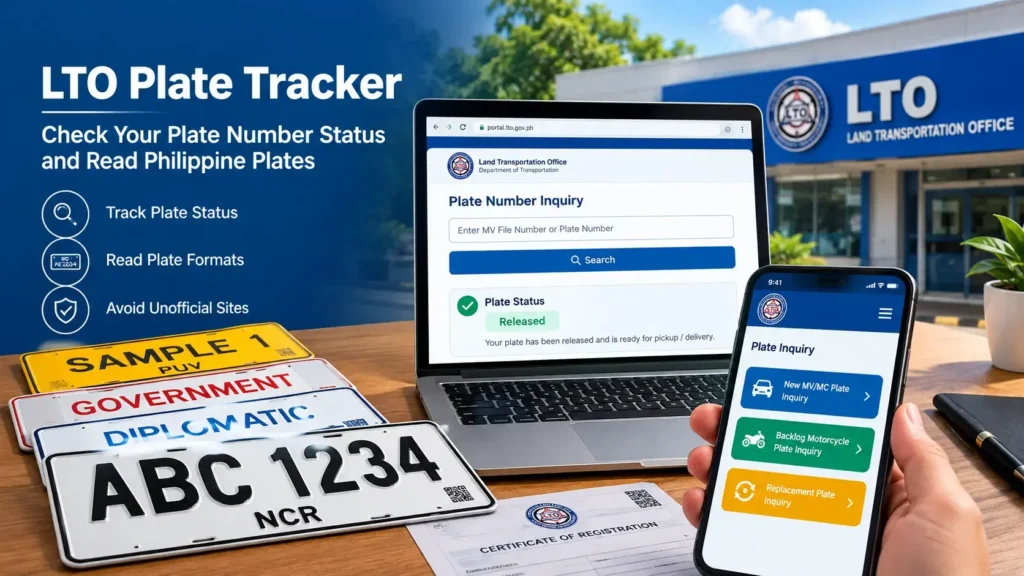
LTO-NCR currently separates plate tracking into three specific inquiry pages rather than one universal tracker, based on what kind of plate you’re waiting on:
New MV/MC Plate inquiry:
For brand-new motor vehicle or motorcycle owners checking whether their plate has already been released to their dealer. Search using your plate number.
Backlog Motorcycle Plates inquiry:
For motorcycles whose assigned plate number isn’t yet shown on their Certificate of Registration (CR), as part of the ongoing backlog. Search using your MV File Number.
Replacement Plate inquiry
For vehicles that applied to replace an old green plate with the current white plate format.
All three are accessed through the official LTO-NCR website, and each applies specifically to transactions originally processed through an LTO-NCR office. If your registration was processed outside NCR, these particular tools won’t return your record, and you should check with your regional LTO office instead.
What the Results Actually Tell You
Rather than a fixed set of universal status labels, the result you get depends on which inquiry tool and transaction type you’re checking. In general, the response will indicate whether your plate has already been released (and to whom, such as your dealer or LTO office), is still being processed, or isn’t yet found in the system for the reference number you entered.
For brand-new vehicles and motorcycles, a released plate typically means it’s already with your dealer, and you’d coordinate pickup from there. For backlog motorcycle plates, a match means it’s available for claiming at the relevant LTO-NCR office. If your reference number returns no result at all, double-check that you’re using the correct inquiry tool for your specific situation, since searching the wrong one is a common source of a “not found” result that isn’t actually a problem with your record.
If your status hasn’t moved in a long time, that alone doesn’t necessarily mean something is wrong. Manufacturing backlogs and regional processing differences both affect how quickly a status updates. If the wait is unusually long compared to what your branch quoted you, contact LTO Customer Service or your issuing LTO-NCR office directly rather than repeatedly refreshing the tracker.
Beware of Unofficial “LTO Tracker” Websites
Search for “LTO plate tracker” and you’ll find a long list of similar-looking sites, many explicitly describing themselves as “independent” or “not affiliated with LTO.” Some are reasonably transparent about this. Others are less clear, and a few request personal information or payment details beyond what an official tracker would ever ask for.
Before trusting any tracker site with your details:
- Check whether it plainly states it’s unofficial or independent. A legitimate reference site will usually say so.
- Never provide payment information to check a status. Official plate delivery fees, where applicable, are paid directly to the accredited courier, not to a website checking your status for you.
- When in doubt, go directly to portal.lto.gov.ph, the official LTO-NCR website (ltoncr.com) for NCR transactions, or LTO’s verified official social media accounts, rather than clicking a tracker link from a search result or shared post.
How to Read a Philippine Plate Number
Since 2018, standard LTO plates for four-wheeled vehicles follow a three-letter, four-digit format (for example, ABC 1234). Motorcycle plates have used several formats over the years as combinations under the original scheme were exhausted.
The first letter always indicates the region where the vehicle was originally registered. In Metro Manila (NCR), plates typically start with N, P, Q, T, U, or X. Other regions across the country have their own assigned letter ranges. The second and third letters mostly continue the sequential numbering system, though certain combinations are reserved for specific categories like electric vehicles or vintage cars.
Plate Colors and What They Mean
Plate background and text color identify how a vehicle is used, not who owns it:
Plate Type | Colors | Used For |
Private vehicles | Black text on white background | Personal cars and motorcycles |
Public utility vehicles | Black text on yellow background | Taxis, jeepneys, buses, and other for-hire vehicles |
Government vehicles | Red text on white background | Vehicles used by government offices, usually with the agency name shown below the plate |
Diplomatic vehicles | Blue text on white background | Foreign embassies, consuls, and recognized international organizations |
Does the Plate Number Itself Mean Anything?
Not really, and this is worth clearing up directly. Beyond the first letter marking your region of registration, the rest of your plate’s letters and numbers don’t encode your birth year, your town, or any hidden personal meaning. Within each region’s series, plates are issued in sequence, the next available combination for that series, so two vehicles registered around the same time can end up with similar-looking plates purely by coincidence. If you’ve seen posts online claiming a specific plate number or digit carries some special significance, that’s not how LTO’s numbering system actually works.
Checking Vehicle Ownership Through a Plate Number
LTO’s plate and registration lookup tools are built for checking your own vehicle’s status, not for looking up who owns someone else’s plate. There’s no general public tool that lets anyone type in a plate number and pull up the registered owner’s identity, and that’s intentional: vehicle owner information is personal data, and LTO doesn’t publish it for open lookup.
If you need to verify ownership for a legitimate reason, such as buying a used vehicle, that verification typically happens through the transaction process itself (checking the OR/CR against the seller’s ID at an LTO office) rather than through an online plate search. If you suspect a plate is being misused, such as on a cloned or fake plate, that’s a matter to report to LTO or the police rather than something to investigate through a public tracker.
Why Is My Plate Taking So Long?
New vehicle registration plates commonly take several weeks to a few months depending on the backlog at the time, renewal plates are typically faster, and transfer-of-ownership plates can take longer still. The exact timeline depends heavily on which processing batch or series your application falls into, and this shifts as LTO continues working through its broader manufacturing backlog. If you’re specifically waiting on a motorcycle plate, note that under RA 12209, LTO was given until June 30, 2026 to produce, release, and issue the required motorcycle plates.
In the meantime, your paper conduction sticker or temporary document serves as your legal proof of registration. If your wait significantly exceeds what your branch originally quoted, that’s the point to escalate directly with LTO Customer Service using your MV File Number, rather than assuming nothing can be done.
Common Mistakes When Tracking a Plate
Using the wrong reference for the wrong inquiry tool is one of the most common snags. Backlog motorcycle plates are checked by MV File Number specifically because no plate number exists on the CR yet, while brand-new vehicle and motorcycle plate checks use the plate number itself. Using the reference that matches your actual transaction type avoids most “not found” results.
Assuming a stalled status means something is broken frequently causes unnecessary stress. Backlogs move in batches, and an unchanged status for a few weeks isn’t automatically a red flag.
Trusting an unfamiliar tracker site with personal or payment information is a common and avoidable risk. Stick to official channels for anything beyond a basic status check.
Believing your plate number has hidden personal significance, tied to a birth date, lucky number, or similar, is a common misconception. It’s simply the next available number in the applicable regional series.
Frequently Asked Questions
LTOTracker is LTO and DOTr’s official platform for checking the real-time status of your driver’s license or vehicle plate, and for arranging home delivery through an accredited courier, launched in 2025.
For LTO-NCR transactions, use the official LTO-NCR website’s specific inquiry tool for your transaction type: new MV/MC plate, backlog motorcycle plate, or replacement plate. Outside NCR, check with your regional LTO office or start from portal.lto.gov.ph for current guidance.
No. LTO doesn’t provide a public lookup tool for identifying a vehicle’s registered owner from its plate number, since that’s personal information.
It indicates the region where your vehicle was originally registered. NCR plates typically start with N, P, Q, T, U, or X.
This usually means your record hasn’t been encoded yet, your application is still in an early backlog stage, or you’re searching the wrong inquiry tool for your transaction type. Backlog motorcycle plates use the MV File Number specifically; brand-new vehicle and motorcycle plates use the plate number. Double-check you’re on the matching tool before assuming something is wrong.
Yes. White background with black text is for private vehicles, yellow is for public utility vehicles, red is for government vehicles, and blue is for diplomatic vehicles.
It varies depending on the current backlog and which processing series your application falls under. Confirm your specific status through the current official LTO or regional LTO inquiry tool rather than assuming a fixed number of weeks.
Final Thoughts
Tracking a plate comes down to two things: using the inquiry tool and reference number that actually match your transaction type, and sticking to official LTO channels rather than an unfamiliar site that just happens to rank well in search results. The plate itself is simpler than it looks once you know the format, a region letter, a sequential code, and a color that tells you how the vehicle is used, nothing more mysterious than that.
For details on the number coding schedule tied to your plate’s last digit, see our Number Coding Hours guide.