
Number Coding Hours in Metro Manila: The Complete MMDA Schedule and Window Hours Guide
If you drive in Metro Manila, “coding hours” is probably one of the first things you check before leaving the house. It’s the single question that decides whether you take the car out today or call a Grab instead. This guide covers the full coding schedule by plate ending, what window hours actually mean, how Makati and other cities differ from the standard rule, and where to check if coding has been suspended today.
Last updated for 2026. MMDA schedules, suspensions, and city-specific rules change from time to time, so always confirm current status through official MMDA channels before you drive.
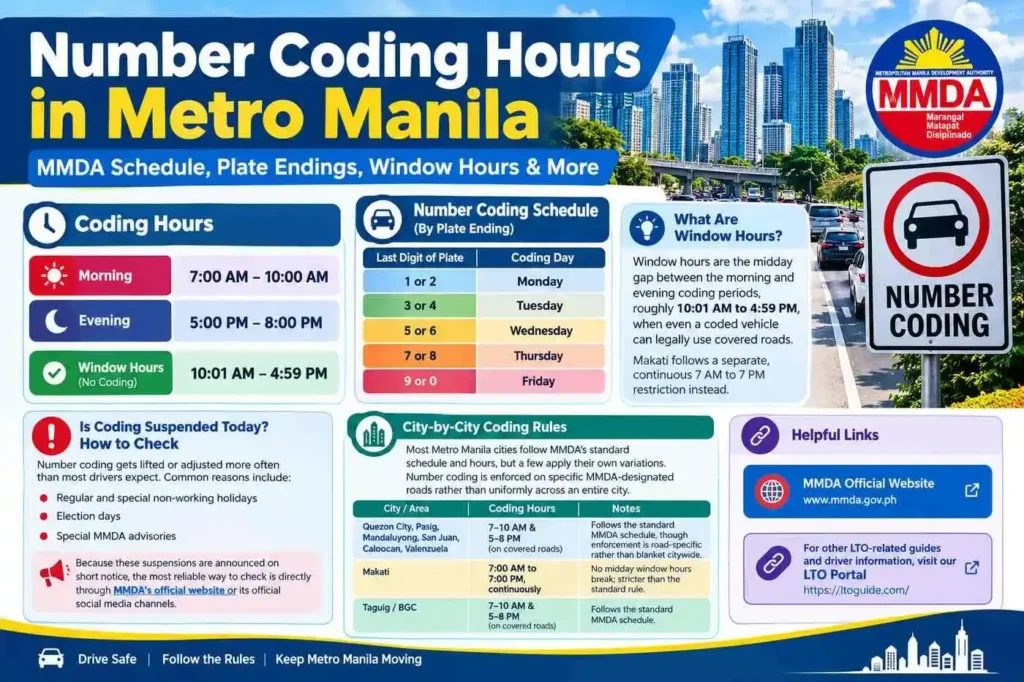
What Are Number Coding Hours?
Number coding, officially the Unified Vehicular Volume Reduction Program (UVVRP), is the Metro Manila Development Authority’s (MMDA) system for reducing traffic by banning private vehicles from major roads on one weekday, based on the last digit of their plate number.
The standard coding hours are:
- 7:00 AM to 10:00 AM (morning rush)
- 5:00 PM to 8:00 PM (evening rush)
Between these two windows, from 10:01 AM to 4:59 PM, coded vehicles are free to drive. This gap is what most drivers call window hours.
Number Coding Hours in Metro Manila: Schedule by Plate Ending
Your coding day depends entirely on the last digit of your plate number:
Last Digit of Plate | Coding Day |
1 or 2 | Monday |
3 or 4 | Tuesday |
5 or 6 | Wednesday |
7 or 8 | Thursday |
9 or 0 | Friday |
The regular MMDA scheme is not enforced on weekends or declared Philippine holidays, though local traffic rules or special advisories tied to specific events can still apply.
What Are Window Hours, Exactly?
Window hours refer to the midday gap between the morning and evening coding periods, roughly 10:01 AM to 4:59 PM, when even a coded vehicle can legally use covered roads. For roads covered by the standard MMDA scheme, this midday break generally applies. Makati follows a separate, continuous 7 AM to 7 PM restriction instead.
Window hours exist specifically because MMDA’s coding rule only targets rush-hour congestion. Outside those two windows, and outside your coding day entirely, there’s no restriction on your vehicle at all.
Is Coding Suspended Today? How to Check
Number coding gets lifted or adjusted more often than most drivers expect. Common reasons include:
- Regular and special non-working holidays. These generally suspend the MMDA number coding scheme, although local or special traffic rules may still apply.
- Election days. These may be covered by a special MMDA or local traffic advisory, so check the latest announcement before driving.
- Special MMDA advisories. Temporary suspensions can be announced because of major events, emergencies, or other traffic-related circumstances.
Because these suspensions are announced on short notice, the most reliable way to check is directly through MMDA’s official social media channels or the MMDA website, rather than a fixed list on any single guide, including this one.
City-by-City Coding Rules
Most Metro Manila cities follow MMDA’s standard schedule and hours, but a few apply their own variations. Number coding is enforced on specific MMDA-designated roads rather than uniformly across an entire city, so a road you frequently drive may not be covered even in a city that generally follows the standard rule:
City / Area | Coding Hours | Notes |
Quezon City, Pasig, Mandaluyong, San Juan, Caloocan, Valenzuela | 7–10 AM & 5–8 PM (on covered roads) | Follows the standard MMDA schedule, though enforcement is road-specific rather than blanket citywide |
Makati | 7:00 AM to 7:00 PM, continuously | No midday window hours break; stricter than the standard rule |
Taguig / BGC | Follows a separate local policy | Confirm current rules directly with the local government, as they differ from the MMDA standard |
Las Piñas | Specific road-level restrictions apply | Not identical to the citywide MMDA rule |
Alabang–Zapote Road, Ayala–Alabang National Road | 7–10 AM & 5–8 PM | Applies only to these specific roads, not all of Muntinlupa |
Cavite | Provincial number coding remains suspended under the current provincial policy | Confirm with Cavite authorities before traveling, as this differs from Metro Manila’s MMDA rule |
Because local ordinances can change independently of MMDA’s citywide rule, always double-check the specific city or road you’re driving through, especially Makati, where the continuous 7 AM to 7 PM rule catches many drivers off guard.
EDSA and Major Expressways
EDSA follows the standard MMDA number coding schedule, the same digit-to-day table used across the rest of Metro Manila.
If you’ve read about an “EDSA Odd-Even Scheme” restricting vehicles by odd or even plate endings, that rule is not currently in effect. It was originally announced alongside a planned two-year EDSA rehabilitation project, but MMDA officially cancelled the odd-even scheme on June 1, 2025, when President Marcos ordered that original rehabilitation plan suspended. A revised, shorter rehabilitation project restarted in December 2025 under a compressed timeline using nighttime construction work, and by mid-2026 it had progressed well past the halfway mark. Throughout this rehabilitation work, standard number coding has continued to apply on EDSA, and no MMDA advisory has reinstated the odd-even scheme. Some older guides online still describe it as active; treat that information as outdated.
Expressways and elevated tollways, such as Skyway, SLEX, and NLEX, generally fall outside MMDA’s local coding jurisdiction, though this can vary by specific entry and exit point. If you’re routing through one to avoid coding on surface roads, confirm current rules with the toll operator rather than assuming blanket exemption.
What Happens If You Get Caught Violating Coding
Driving on your coding day during restricted hours typically results in a traffic citation and a fine, issued either by MMDA enforcers or the local city traffic management office, depending on where you’re apprehended. The exact fine amount varies by city ordinance and by how many times you’ve been cited, so rather than quoting a fixed peso figure here that may be outdated or city-specific, check the citation itself or your local traffic office for the current amount.
If you receive a ticket, follow the instructions and amount printed on the official citation rather than relying on a general fine table from any website, since enforcement and penalty schedules aren’t fully uniform across Metro Manila’s cities.
Who’s Exempt From Number Coding?
Certain vehicles and situations are generally exempt from coding restrictions, though specifics can vary by city:
- Motorcycles, in most Metro Manila cities (Makati is a notable exception, where coded motorcycles face the same 7 AM to 7 PM restriction as cars)
- • Public utility vehicles and vehicles providing emergency services
- Government vehicles on official business, typically marked accordingly
- A valid MMDA exemption pass, where an exemption is available for the driver’s specific qualifying circumstance
Senior citizens are not automatically exempt from coding; they still need a valid MMDA exemption pass if they require one.
Common Mistakes Drivers Make With Coding
Assuming Makati follows the standard window hours is one of the most common and costly mistakes. Its 7 AM to 7 PM rule runs straight through, with no midday break.
Relying on an old article for EDSA’s odd-even status is another frequent trap, since that scheme was cancelled in mid-2025 and hasn’t returned, despite still being described as active on several outdated guides.
Assuming a holiday automatically applies citywide the same way everywhere can also cause confusion, particularly around city-specific road closures or special advisories layered on top of the standard rule.
Forgetting that window hours don’t apply in Makati leads some drivers to plan a midday errand there assuming the same break available elsewhere in Metro Manila.
Frequently Asked Questions
The standard MMDA coding hours are 7:00 AM to 10:00 AM and 5:00 PM to 8:00 PM, Monday through Friday. Makati is the main exception, running continuously from 7 AM to 7 PM.
Window hours are the midday period, roughly 10:01 AM to 4:59 PM, when even a coded vehicle can drive freely on covered roads. Makati does not observe this break.
It depends on the date. Weekends and declared holidays generally suspend coding, and election days are often covered by a special advisory. Beyond that, check MMDA’s official channels for any special announcement, since temporary suspensions can be issued with little notice.
No. MMDA cancelled the odd-even scheme in June 2025. The EDSA rehabilitation project it was tied to was itself paused around the same time, then restarted in December 2025 under a revised, shorter timeline. Standard number coding has applied throughout, and no MMDA advisory has reinstated the odd-even scheme as of 2026.
Generally, expressways and elevated tollways fall outside MMDA’s coding jurisdiction, though this can depend on the specific entry or exit point. Confirm with the toll operator if you’re unsure.
In most Metro Manila cities, no. Makati is the exception, where coded motorcycles follow the same 7 AM to 7 PM restriction as cars.
Yes. Vehicles registered outside Metro Manila must still follow the coding schedule while driving within areas where it’s enforced.
Final Thoughts
Number coding hours look simple on paper: match your plate’s last digit to a weekday, avoid the two rush-hour windows, and you’re generally fine. The complexity comes from the exceptions, Makati’s continuous rule, city-specific road restrictions, and the occasional suspension that doesn’t always make national headlines. When your day depends on it, check MMDA’s official channels directly rather than relying on a schedule that might be a year out of date.
For details on the DL codes and vehicle classifications tied to your license, see our DL Code B guide.